Siege of Ainlen
Contents
 War Against Rhalûin
Background
By 1157 D.T., Rhalûin's shadow had lengthened across Ered, with turg raids and dragon-sightings sowing terror from the southern seas to the northern plains. The Grondanâ, nomadic descendants of Skebhos and Alewul, dwelt in scattered villages like Ainlen on the eastern fringes of Fjalgârn, vulnerable to eastern incursions. Ainlen itself was a modest settlement of thatched halls and herding pens, home to several hundred, including distant heirs of Olngirr's preserved line. Rhalûin, seeking to weaken potential allies before his full assault on Elárin, dispatched turg war-bands to probe and destroy outlying human strongholds. The attack on Ainlen came without warning on a clear Ebrekhorn dawn, catching the village in the midst of daily routines.
The Siege
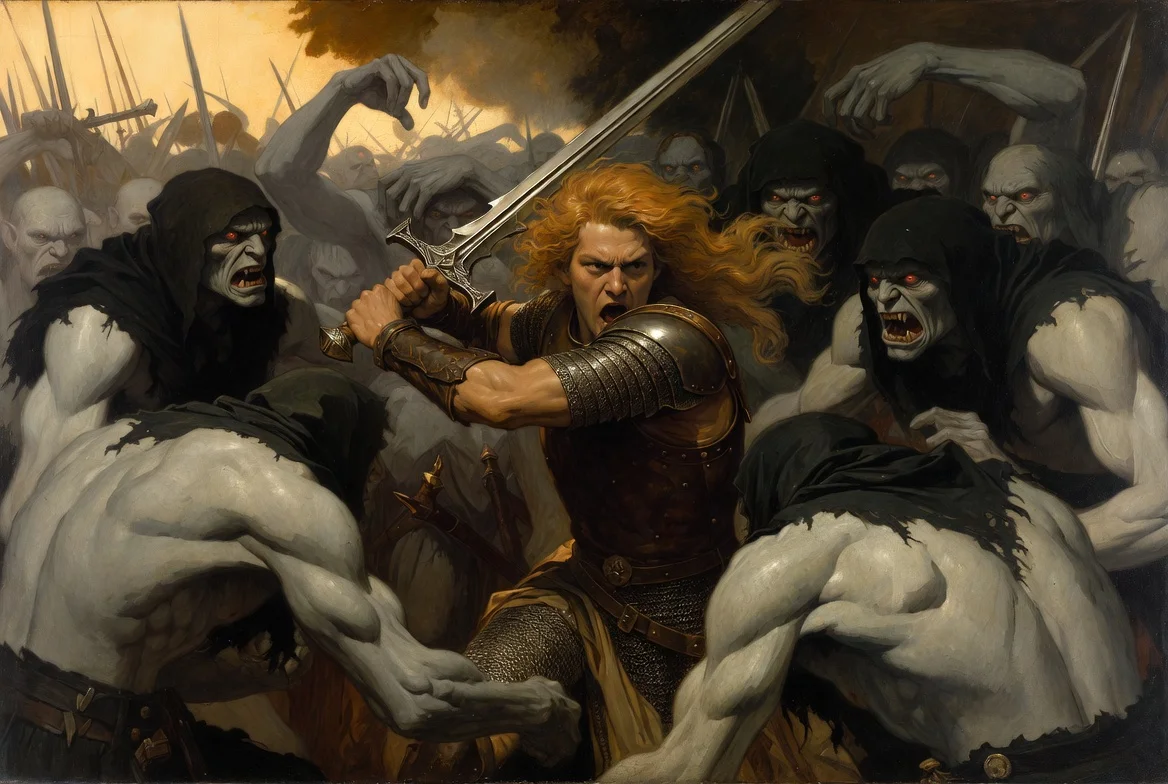
As the turg horde—roughly three-hundred strong, clad in ragged hides and bearing jagged axes—descended from the eastern mists, LunrithErtbhöt, chieftain and son of Lord Eundolun, was among the first to spot the threat. Already scarred from prior skirmishes, he rallied the few able warriors with a broken shield and dulled sword, positioning himself on a low hill at the village's edge. His urgent shouts gave the women, children, and elders precious minutes to flee westward toward safer clans.
For hours Lunrithfought alone as his militia fell around him, his fiery red hair and ember-bright eyes becoming a beacon of defiance. He slew turg after turg, piling their bodies like a makeshift rampart until the ground ran crimson. Overwhelmed at last, he collapsed across the slain, his final breath urging the last survivors to run. The turgs, their numbers decimated, razed Ainlen in vengeance but failed to pursue the escapees, who carried the Olngirr bloodline to safety in hidden camps.
Aftermath
The siege left Ainlen a smouldering ruin, its halls burned and fields trampled, but Lunrith's sacrifice ensured the survival of key lineages, including Olngirr's heirs who would later shape the fate of Men. The Grondanâ anointed his body with oil where it fell, and over centuries his bones sank into the earth, giving rise to the sacred red-leaved tree Fabhean. The site became a shrine in the Moorlands of Halamil, venerated by both Men and elves as the place where one man's valor blunted a tide that might have reached Fjalgârn itself.
Legacy
The Siege of Ainlen immortalized Lunrithas Ertbhöt (“Red Tree”), symbol of unyielding sacrifice. Centuries later, in fulfillment of prophecy, Háldor felled Fabhean to save his sister-in-law Earen and her child Eidróna, whose red hair echoed Lunrith's own. The event is commemorated in the epic poem To Races Free Alike, which captures the heroism and tragedy:
To races free alike, a tale of glory this has been
A story none can match, perhaps until Ered doth end
Of times when purer hearts were born and valor would amend
The broken hearts that dared to beat, for fear of bitter endA mighty man was Lunrith, son of High Lord Eundolun
He stood so tall, and battle was to something he would run
To fight the evil of the day that dared walk in the Sun
O, Lunrith, brave! The curse of darkness broke, the pangs undoneWith hair of fiery red and skin of dark, the stories told
A warrior fierce, his mighty stance a bold sight to behold
His eyes like burning embers, heart a forge of courage cold
In Lunrith's veins, the blood of ancient heroes did unfoldFor many turgs did rush upon the homes of righteous kin
Our nation stood so feeble, in the bare and blowing wind
The axe and sword of ogres felled the noblest of our men
But Lunrithheld much longer, when others could not defendA broken shield he wielded, and his sword was red and dull
In pain he shouted for the village folk to flee in full
The bodies built around him, like the great mountains of old
But fought he hard until his mighty string of death was pulledA hundred turgs he felled into the crimsoned grassy soil
And on them lay his body, sleeping with the battle’s spoil
The wicked underneath him, by his hand he did embroil
With solemn hearts, the Grondanâ anointed him with oilFor years, the bones lay rested on the ever saddened ground
But over time, the bones they sunk, and miracle was found
For as the rain did fall upon the grave, the glorious mound
A red tree shot from there, and to it history is bound